
How one Ghanaian firm won gold by going green
Koranteng & Koranteng’s managing partner and two associates discuss impact, ambition and how their firm is redefining corporate responsibility in Ghana
Ghana-headquartered law firm Koranteng & Koranteng was founded in August 2020 and has since grown into a nine-lawyer practice, supported by four ancillary staff members. From the outset, it has sought to align commercial legal practice with a broader sense of corporate social responsibility.
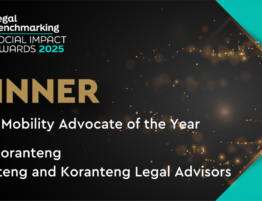
The firm’s approach received formal recognition in 2025, when it was named winner of Social Mobility Firm of the Year prize at the Legal Benchmarking Group Social Impact Awards. Its co-founder and managing partner, Afua Koranteng, also picked up an individual award for Social Mobility Advocate of the Year.
Talking to IFLR, Koranteng says it was in 2024 that the firm made a deliberate decision to formalise ESG as a core part of its strategy.
“The timing was intentional,” she says. “ESG has become a key focus across all sectors in Ghana and globally, driven by a growing awareness of how closely our environment affects our lives.”
For Koranteng, the decision reflected a broader trend of how climate change and environmental sustainability have become front and centre of how businesses operate in the region.
“For us, the move felt natural because ESG was already embedded in what we were doing,” she tells IFLR. “When we considered how to clearly demonstrate our commitment to ESG and differentiate ourselves, the environmental pillar was a natural starting point.”
The ‘governance’ pillar, in particular, has always been embedded in the firm’s professional work.
“We advise clients on governance matters daily,” says Koranteng. “I also sit on the board of a bank, where ESG forms part of regulatory requirements.
“These experiences reinforced our decision to make ESG a core part of our business strategy rather than a standalone initiative.”
Going green
Green Palette is the name of the firm’s flagship environmental initiative. Structured as a non-governmental organisation (NGO), it was deliberately established beyond the confines of the firm itself.
“While Green Palette is a corporate social responsibility (CRS) initiative, it needed to stand on its own with a clear and independent focus. That is why we registered it as an NGO.”
It is intended to operate with its own identity and credibility, enabling partnerships with corporates, institutions and international bodies on a footing that extends beyond a single law practice.
The name reflects that vision. “Green” signals its environmental focus, while “Palette” suggests creativity, diversity of ideas and a range of practical interventions.
“When we first mentioned Green Palette internally, art was a part of it. We were going to look at the environment and then art, and how we could merge the two,” says Irene Clottey, an associate in the firm’s M&A, corporate, commercial law, banking and finance, and dispute resolution practices.
“At the same time, we were confronted with a very real issue around us – just behind our office, people were dumping plastic waste.”
To illustrate how sustainability and creativity intersect, participants at a recent Green Palette Conference transformed plastic waste into desks, trays, and slippers, demonstrating how discarded materials can be repurposed into practical and artistic creations.
Clottey, who joined the firm in November 2022, was drawn by its culture and diversity and an opportunity to build experience in corporate and commercial law. Discussing the initiative and its goals, she adds that it was born out of a commitment to move out of the typical stereotype of CSR.
“CSR has been put in a small box,” she notes. “We wanted to be known as a green firm. We wanted to do more than just that one activity for the year. We wanted to create an impact.”
Her ambition for the initiative is long-term. “For me, I want Green Palette to become a household name. Too often, initiatives like this launch with a lot of energy in the first six months and then fade away. I don’t want Green Palette to be another short-lived vision.”
Ideal outcomes
Ama Obese-Jecty is one of Koranteng & Koranteng’s lawyers involved in the Green Palette initiative.
An associate in the firm’s commercial, finance and investment practices, she joined in 2021 as a trainee before becoming an associate in 2022.
Obese-Jecty tells IFLR she was keen to be part of the initiative as she had not seen one like it in Ghana before.
“From the outset, the idea of blending art with issues like climate change and plastic waste, and bringing together diverse stakeholders to explore practical solutions, immediately stood out to us,” she recalls. “It had clear potential to drive meaningful, positive change, which is why I was particularly drawn to the initiative.”
She draws attention to several environmental issues in the country, including illegal small-scale mining, linked to widespread deforestation, severe pollution of water bodies and health challenges in the affected communities.
That’s why Obese-Jecty’s ambition for Green Palette is to secure a higher number of partnerships which will help tackle some of these issues.
Koranteng’s own vision for the initiative is structural independence. “My vision is for Green Palette to exist beyond any association with the law firm and to stand fully on its own as an independent entity.”
She recalls a recent example that reflects that trajectory: an energy-sector client approached the firm after seeing its work related to plastic recovery in forest areas affected by mining, and expressed interest in collaboration, potentially involving embassy support.
“Moments like that show the direction I’d like Green Palette to take – being the first point of reference when environmental issues arise,” she notes.
Business impact
Alongside its environmental focus, the firm continues to engage in broader social initiatives. Since 2022, it has participated in Green Ghana Day, planting trees and returning the following year to monitor and plant more. It has delivered career talks at universities and local schools, donated books and equipment, and supported children’s homes with food, school materials and time spent understanding their needs.
From a commercial perspective, it is often debated whether ESG initiatives translate into commercial opportunities for law firms.
For Koranteng & Koranteng, the response is measured. When asked if initiatives like green Palette have opened doors to more business opportunities, Koranteng says: “Possibly, indirectly.”
Since launching Green Palette last year with a stakeholder conference, the firm has received support from the United Nations (UN), including the UN Global Compact, as well as corporates, banks and sustainability-focused organisations.
“These relationships have increased our visibility and credibility,” Koranteng explains.
“We now receive referrals, but not only of new business – referrals where someone sees insights, information related to pollution, plastics and ESG, and forwards it to us. That is simply because people associate us with this space.
“Although we only began last year, the initiative has already led to increased attention and international referrals, including inquiries from foreign businesses looking to operate in Ghana.”
For Clottey, the defining feature of initiatives like Green Palette remains the act of beginning.
“As corporate institutions, we often focus on the bigger picture. But when it comes to the environment, sometimes the problem and the solution exist in the same space – it just takes taking the first step,” she says.
“When you’re passionate about finding a solution, getting started is what matters most, and I’m proud that Green Palette took that leap.”
Noemi Distefano
Senior Reporter IFLR