

MTN Ghana vs. NCA: Telecoms giant heads to Supreme Court for review
Telecommunications giant, MTN Ghana, has filed an application at the Supreme Court seeking a review of the High Court ruling that quashed its suit against the National Communication Authority’s declaration of the network as a Significant Market Power (SMP).
MTN Ghana has said it took this action on Friday September 4, 2020, after a careful review of the ruling of the Commercial Division of the High Court.
The High Court of Justice (Commercial Division) on September , 2020 dismissed MTN’s application for a judicial review of the declaration by the National Communications Authority (NCA) of MTN Ghana as a Significant Marķet Power, SMP.
MTN had stated earlier that although it respects the decision it was not satisfied with the ruling.
In a statement issued by the company on Saturday, September 5, it said concerns regarding the National Communications Authority’s (NCA) declaration of the telecoms giant as Significant Market Power (SMP) remains unresolved, hence their decision to go to the Supreme Court.
“MTN Ghana respects the decision of the Court, however in our opinion the judgement did not address our concerns that the NCA’s decision did not meet the requirements of procedural fairness,” it said.
MTN Ghana however said,” we acknowledge the duties and powers of the NCA to promote fair competition amongst licensed operators. We also support the legitimate exercise of the NCA’s regulatory powers, but as a good corporate citizen and considering the international investment community, we believe that a decision by the highest court of the land would provide certainty and a veritable precedence on the procedural fairness in this, and future regulatory decisions of the Authority. This will no doubt safeguard the interest of customers, shareholders, investors and the wider industry.”
“We believe Friday’s step still provides an opportunity for further engagements with the regulatory authorities. Indeed, MTN Ghana continues to reach out to the regulator and key stakeholders to have the concerns of both sides addressed in a collaborative and amicable manner.
MTN Ghana further assured its cherished customers and other stakeholders of its unflinching commitment to its regulatory obligations and support for the Ghanaian Government’s efforts to enhance growth and competition in all segments of the telecommunications market.
Background
The Ministry of Communications in June this year, directed the National Communications Authority (NCA), to enforce provisions of the Electronic Communications Act, 2008 (Act 775) and the National Telecommunications Policy (NTP) to address disparities in market and revenue share in the telecommunications sector.
Following the directive, the NCA was expected to start an immediate implementation of specific policies to ensure a level-playing field for all network operators within the industry, with emphasis on maximizing consumer welfare as the growing dominance of MTN “has impacted negatively on competition and consumer choice, necessitating corrective action.”
According to NCA, MTN had a market share of 46% as at 2016, but now holds about 58% of voice and 68% of data in 2020.
But in a statement issued on Friday 26th June, 2020, MTN Ghana said although there were ongoing discussions with the regulatory authority to decide the way forward, NCA has already began implementation of the specified policies, hence, its decision to finally seek redress at the law court, after it was officially notified of the decision.
In the suit, MTN asked the Court to quash NCA’s decision, arguing that the regulator did not give it a fair hearing before declaring it a Significant Market Power; and that such a refusal offends the NCA Act itself.
MTN also wanted the High Court to prohibit NCA from further circulating or acting on the said decision.
But the Court, presided over by a Justice of the Court of Appeal, Samuel Asiedu, sitting as additional High Court Judge, said unless MTN successfully proved that NCA was “discharging its functions in a manner not sanctioned by law, it will not be proper for a restraint order to be issued against [NCA]”.
Based upon this, the Court said it was unable to stop NCA from circulating or acting on its declaration of MTN as a significant market player.
The Court opined that the opportunity offered to MTN to make input by way of data fulfills the requirement of due process and procedural fairness. It however added that MTN is still permitted by law to engage NCA on the implementation.
The Minister of Communications, Ursula Owusu-Ekuful, has also in an interview with Citi Business News welcomed the High Court’s ruling, saying the decision will give the NCA the opportunity to begin work on the implementation of specific measures within the telecommunications industry to provide a level-playing field for all network operators.
source: citi business news

High Court throws out MTN over monopoly in Ghana
The Accra High Court has dismissed the case by MTN, which was seeking the court to quash the decision by the National Communications Authority (NCA) to classify it as a significant market player (SMP) in the telecommunications industry in Ghana.
The court at its sitting on Tuesday, September 1, 2020 dismissed MTN’s case and also awarded cost of GH¢10,000 against the giant mobile network company, according to the ruling which is available to Graphic Online.
The decision, Graphic Online understands, means that the NCA can now take remedial measures against MTN in order to promote competition, protect other mobile network operators and consumers.
As earlier exclusively reported by Graphic Online’s court reporter, Emmanuel Ebo Hawkson, the legal action by MTN, which challenged the processes that led to it being classified by the NCA as a significant market player (SMP) in the telecommunication industry, commenced at the Commercial Division of the Accra High Court.
MTN went to court with a judicial review application urging the court to quash the NCA’s decision with an argument that the regulator failed to give it a hearing before classifying it as an SMP.
The NCA, however, insisted in its affidavit in opposition to the application that at all material times, MTN was aware and participated in the process that led to it being classified as an SMP.
SMP classification
Pursuant to Section 20 (10) of the Electronic Communications Act, 2008 (Act 775), on June 9, this year, the NCA classified MTN as an SMP after the regulator determined that the mobile network operator controlled more than 57 per cent of the voice market share, as well as more than 67 per cent of the data market share.
Act 775 allows the NCA to take “corrective measures” against an SMP in order to promote competition and protect other mobile network operators and consumers.
In view of that, the NCA decided to “review and approve all charges by MTN”, set caps on what MTN can charge for its services, and also impose a 30 per cent interconnect rate for two years in favour of other “disadvantaged operators.”
MTN’s case
In an affidavit in support of the motion for judicial review deposed by Mr Serlom Adadevoh, the CEO of MTN Ghana, the company averred that the “failure of NCA” to give it a hearing was a violation of the rules of natural justice, as well as Section 25 of the National Communications Act, 2008 (Act 769) which enjoins the NCA to “observe reasonable standards of procedural fairness.”
According to MTN, the “failure of the respondent (NCA)” to give it a hearing renders the SMP classification null and void.
“The respondent (NCA) by not giving applicant (MTN) a hearing prevented respondent from making informed decision, in that applicant was denied and prevented from making any submission before the decision to declare it a SMP was made,” it said.
The mobile network operator, therefore, wanted an order of certiorari from the court quashing the decision of the NCA to classify it as an SMP.
Also, MTN sought an order of prohibition restraining the NCA from implementing the decision to classify it as an SMP and also circulating the decision.
NCA’s opposition
In its affidavit in opposition, the NCA argued that the classification of MTN as an SMP was in compliance with Act 775.
It was the contention of the NCA that it had fulfilled all the requirements under Section 20 (13) of Act 775 including the gazette notification dated June 9, this year.
Also, the NCA said it had adequately engaged MTN on the implementation of its new status as an SMP.
Again, the regulator argued that the process leading to MTN being classified as an SMP started in 2014 when the NCA held discussions with all mobile network operators (MNOs) on regulation of competition in the telecommunication sector.
According to the affidavit in opposition, pursuant to the engagement with the MNOs and in order to gather adequate information, the NCA, in November 2015, hired a global telecom consultancy firm known as Analyses Mason, to “undertake a study to determine whether any particular operator was a SMP.”
“The said study had the participation of the applicant Scancom PLC (MTN Ghana) at all material times. It is therefore untrue for the applicant to claim that it had not been heard in the process,” the affidavit in opposition contended.
It was the case of the NCA that the study by the consultant identified MTN as an SMP with more than 46 per cent of the telecommunication market share as of 2014.
Armed with that information, the NCA said in October, 2019, it commenced another study by engaging the MNOs and using information supplied by them, which again confirmed MTN as an SMP.
source: graphiconline.com
Dissatisfied with the ruling of the High Court, MTN appealed to the Supreme Court. Read more
Cabinet approves new Insurance bill

Deputy Commissioner of Insurance, Michael Andoh
- To deepen insurance penetration
- Offer more protection to workers
Deputy Commissioner of Insurance, Michael Andoh – explaining these three new mandatory insurances, told the B&FT that: “The Public Liability Insurance will be very critical to the nation. People who are going about their everyday business and other people’s negligence affects them accidentally have to be compensated. Sometimes, the people whose negligence they suffer from don’t have what it takes to look after them; so, should their welfare depend on whether whoever caused that negligence has the ability to raise money to look after them? That is a bit difficult”.
He added that this insurance will be mandatory for certain sectors of the economy in which activities can lead to mass destruction of life and property, should there be a disaster.
“If you have a filling station and it explodes and kills a lot of people or injures a lot of people, you don’t have that kind of money to take care of them all; but should we waste their lives because that has happened? That is why we need these kinds of insurance to protect innocent third parties.
“The victims of the Melcom disaster are there; the June 3rd victims are there; the Atomic Gas explosion and Trade Fair gas explosion victims are there with little financial support after incidents which were no fault of theirs. Some of them may be rich and be able to take care of themselves, but some of them will also be going through some hard times and have nowhere to go for support. That is why the new insurance act provides some of these insurances.”
He further indicated that the sectors which will have to compulsorily buy this insurance are Fuel and gas stations, stone quarries, among others.
Explaining what will go into the Professional Indemnity Insurance, Mr. Andor said certain kinds of professionals will be required to buy insurance, so that if they are negligent and make certain mistakes the people who suffer as a result can be compensated in some way.
Also, it will be mandatory for all employers to buy Group Life Insurance for employees. This will be an enhancement of the workman’s compensation.
“The workman’s compensation is already there; the issue is that even though it requires employers to compensate employees who die or get injured while doing their job, it doesn’t compel them to insure that liability. What this Act will do is compel employers to cover these liabilities, so that when an accident occurs they just have to fall on the insurance company to compensate their employee,” Mr. Andoh explained.
source: thebftonline.com

Ghana records highest ever electricity export in two decades
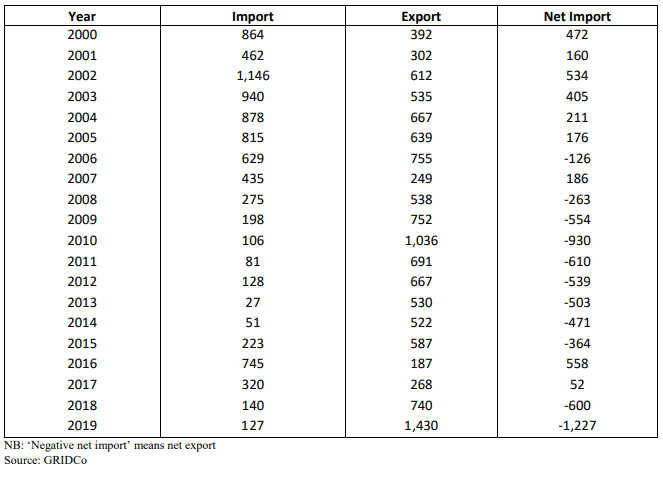
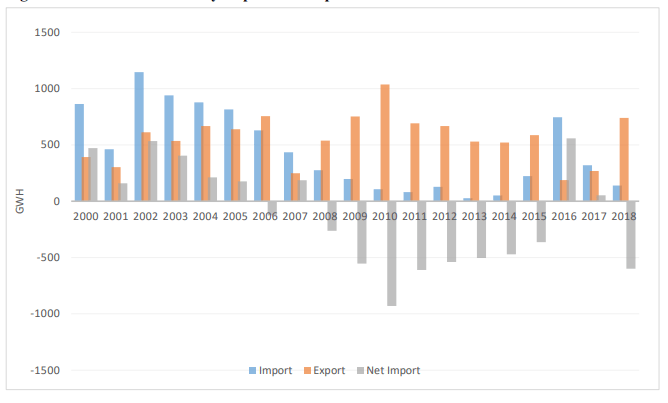
Apart from the significant increase in export, electricity import in 2019 fell to 127 GWh, from 140 GWh which was recorded in 2018. This reduction in electricity is equivalent to 0.7 percent of total generation and the lowest level since 2014. This development led to over a 100 percent increase in net export (export less import) in 2019. From a net export of 600 GWh in 2018, 2019 recorded a net export of 1,227 GWh.
This significant increase in the nation’s electricity, according to the Energy Commission is as a result of the improved installed generation capacity. From an installed capacity of 1,652 Megawatts (MW) in 2000, the capacity has significantly improved to 5,172 Megawatts in 2019
This significant improvement in Ghana’s energy sector was recorded mainly between 2012 and 2019. Some critics have indicated that the increment was so outrageous which has led to the creation of excess capacities which are not needed.
The commission further stated in the report that urgent steps are needed to address the chronic debt in the power sector, since the overall sector liabilities could hit US$12.5bn by the end of 2023.
Find the tabular and graphical representation below:
By: Frederick Addai Kwarteng | fred.kwarteng@abcnewsgh.com
source: https://www.abcnewsgh.com/

SEC moves to protect investors with new directive
In an effort to further protect investors, the Securities and Exchange Commission has issued a new directive to all Capital Market Operators open, maintain and operate Trust Accounts for and on behalf of its clients, effective Thursday, July 16, 2020.
According to the Regulator, the Trust Fund shall hold all monies received from clients or on behalf of clients by Capital Market Operators shall be deposited for the purposes of investment. A Trust Account as determined by SEC, shall not contain any other money except those deposited by clients or on behalf of clients of Capital Market Operators for investment purposes.The Accounts shall be immune to bankruptcy and liquidation proceedings or processes of Court, thus, where a licencee becomes bankrupt or falls into liquidation or incurs a debt, a Trust Account operated by the Capital Market operator shall not be subject to bankruptcy or liquidation proceedings or be used as a payment for the debt.
The Regulator further indicates that monies held in a Trust Account are not available for payment of the debts of Capital Market Operator or liable to be paid or taken in execution under an order or process of a court.
In this regard, a Trust Account shall be separated from other Accounts maintained by the Capital Market Operator for operational or proprietary purposes.
To ensure that Capital Market Operators adhere to the directive, SEC has also directed that all Custodians and Trustees with which Trust Accounts are opened, maintained and operated shall ensure that receipts, payments and disbursements into and from a Trust Account are only in respect of clients investments and the beneficiary on behalf of whom the receipt, payment and disbursement is made is clearly identified by name and Identity card so that the entries on the Trust Account can be reconstructed such that a statement containing all debits and credits on the Account can be attributed to individual beneficiaries. The Commission further stated that where it appears to a Custodian or Trustee that a Trust Account is not being used for the purposes above, the Custodian or Trustee shall notify the Regulator immediately before the transaction in question passes or is effected by the Custodian or Trustee. Any Capital Market Operator that breaches the directive will be subject to sanctions under section 209, 159(7), (8), 160(1)(d), 160(2), 160(7)(8), and/or any other relevant provision applicable under the Securities Industry Act 2016 (Act 929), which includes revocation of license.
GSB