

Zeepay Partners With Visa to Make Foreign Remittance Easier for Africans.
Zeepay, a fast-growing African fintech, has announced a partnership with Visa that will allow Africans in the diaspora to send money directly onto Visa debit and prepaid cards in Ghana.
Through the partnership, Zeepay will integrate Visa’s real-time push payments solution Visa Direct, with Instntmny, its money transfer platform, to provide users of the Zeepay app a fast, convenient and secure way to receive money and remittances directly into their eligible card credentials. This will significantly expand Zeepay and Visa’s reach and ability to open up commerce to the country.
The initial deployment phase will commence across Zeepay’s European and North American corridors and then expand to all major corridors globally. Visa Direct enables consumers to send money, share costs, and support family around the world. With this partnership, Ghanaians will enjoy efficiency, global scale and better digital experiences and instant access to funds from friends and family abroad.
Dede Quarshie, Chief Commercial Officer at Zeepay, speaking about the service said: “the service will immediately be available to over 2 million Visa card holders in Ghana. We believe this service will further deepen our financial inclusion drive across Ghana and Africa at large.
The strategy is to present the consumer with various options for receiving remittances from abroad including Visa debit and prepaid cards, mobile money wallets, ATMs and Bank accounts. Our omni channel approach makes Zeepay the preferred partner for remittance payout.
“We are delighted to bring this service to Ghanaians, and we would like to thank our banking partners – ADB and GTBank for all the support,” Ms. Quarshie added.
“Championing the fintech community and our partners to drive the next generation of digital payments is core to our growth strategy at Visa,” said Adoma Peprah, Country Manager, Visa Ghana.
“We are excited about our strategic collaboration with Zeepay, which will open new doors for meeting the needs of today’s consumer and continue to contribute to the betterment of the global payments ecosystem.”
Over the past decade, Ghanaians have adopted a mobile-led, digital payments ecosystem and Visa’s objective in the region has been to accelerate the distribution of payment credentials and expand the acceptance space for digital payments. This partnership with Zeepay is an essential step towards achieving that goal.
Source: thebftonline.com

National Cyber Security Month Begins Today
The Ministry of Communications through the National Cyber Security Centre (NCSC), an agency with the mandate to coordinate Ghana’s cybersecurity development, will hold its annual National Cyber Security Awareness Month (NCSAM) from October 1st to 31st, 2020.
The month-long event will be conducted in a hybrid format comprising physical engagements (under strict COVID-19 protocols) and the use of virtual platforms including live stream on NCSAMTV, Facebook, YouTube and updated across various social media pages such as Instagram and Twitter.
It will involve thought-leadership sessions, panel discussions, workshops and media engagements aimed at intensifying capacity building and awareness creation efforts on cybercrime and cybersecurity issues among Ghanaians, a statement signed and issued by the Head of Public Relations at the Ministry of Communication, Naa Korkoi Essah said.
Recognized as the leading event within the cybersecurity space, NCSAM will educate children, the public, businesses and government stakeholders on cyber hygiene best practices, consistent with the Safer Digital Ghana campaign, the statement said.
This year’s event will have weekly high-level events; Launch of the National Cyber Security Awareness Month and Child Online Protection Reporting Portal, Forum on Impact of COVID-19 on Ghana’s Digitalization Agenda, Cybersecurity Forum with Industry Players and the other activities covering the four pillars of the Safer Digital Ghana campaign (Children, the Public, Businesses and Government).
Speakers include Mrs Ursula Owusu-Ekuful, Minister of Communications, Members of the National Cybersecurity Inter-Ministerial Advisory Council (NCSIAC), Ambassador Stephanie S. Sullivan, United States Ambassador to Ghana, Mrs. Anne-Claire Dufay, Country Representative of UNICEF Ghana, Mr George Nenyi Andah, Deputy Communications Minister, Mr Alexander K.K Abban, Deputy Communications Minister, Dr. Albert Antwi-Boasiako, National Cybersecurity Advisor, Members of the National Cybersecurity Technical Working Group and non-governmental stakeholders including Deloitte, ISACA, e-Crime Bureau, Innovare, Surfline, Margins Group, Zerofox, CalBank among others.
The event will also attract collaboration with Ghana’s cybersecurity partners, including the Council of Europe, UNICEF, Security Governance Initiative (SGI) of the US Government and the Freedom Online Coalition (FOC) among others.
Speaking on the event, Mrs Ursula Owusu-Ekuful, Minister of Communications said, “COVID-19 pandemic has changed our way of life and this event will focus on the how our Children, the Public, Businesses as well as Government institutions can ensure utmost protection of their online activities whilst utilising digital platforms”.
The theme for this year’s edition is “Cybersecurity in the era of COVID-19”, reflecting on the current trends on cybersecurity incidents as a result of the increasing use of digital platforms by individuals, businesses and Governments for socio-economic activities in view of the global COVID-19 pandemic.
The official hashtag for the event is #NCSAM2020 and #SaferDigitalGhana and will be streamed on all social media platforms.
source: graphiconline.com

Parts of Accra Soon to Be Powered by Solar Energy
A renewable energy firm, Axcon Energy Limited has kicked off the construction of Appolonia City’s first solar power plant, which will bring five megawatt (MW) of renewable energy to homeowners and businesses within Greater Accra’s new city.
The solar plant, located in Appolonia Industrial Park, provides additional capacity to Appolonia City’s dedicated power substation.
A press release issued by Appolonia City on September 11 in Accra, quoted the Chief Executive Officer (CEO) of Axcon Energy, Mr Pascal Siamey, saying that the new solar plant will satisfy load growth and provide clean and reliable power for Appolonia City, especially for businesses in Appolonia Industrial Park.
“We are excited to be doing this in Appolonia City, because its well-structured utility delivery plan and commitment to renewable energy solutions are commendable,” it stated.
The solar power will be connected on the 11 kilovolt (kV) side of the dedicated 33/11 kV substation within Appolonia City.
The power will then be distributed to the homes and industrial clients through Appolonia City’s electricity distribution network.
Appolonia City already receives supply from the national grid via a 33kv overhead line, serving a dedicated 60 mega volt amp (MVA) primary substation. There will be further substations as the city grows.
Solar power
The release also quoted the Chief Executive Officer (CEO) of Appolonia City, Mr Bright Owusu-Amofah, of saying that the Appolonia City’s first solar power plant was good news for industrial and residential owners.
“One of our promises is to provide world-class utility services to our residents, and solar power will augment the existing reliable power supply within the city, present superior value to our residents and underpin our renewable energy strategy.”
Appolonia Industrial Park is a 200-acre zone within Appolonia City’s 2,325-acre development with high-quality infrastructure specifically engineered for light industrial uses.
In addition to Axcon Energy, other local and international companies are also developing facilities at the park, including MainOne, Nickseth Construction, Alusynco, Crownhouse Construction & Logistics, PUMA Energy, and Total Ghana.
Source: graphiconline.com

Energy as a Catalyst to the 4th Industrial Revolution in Africa
Mrs. Afua Koranteng was a panelist at the Virtual Study Abroad Program for the Imperial College of London’s Business School Weekend MBA Program held on Saturday September 26th, 2020 at 11.45 GMT. The program was organized by the Hill Top Global Group together with the Imperial College of London.
She spoke on the theme, “Energy as a Catalyst to the 4th Industrial Revolution in Africa”.
Harnessing her firsthand experiences in the Ghanaian power sector, she spoke eruditely on the legal and government issues affecting the power sector in Ghana.

It Is Time To Improve The Presence Of Women On Boards
Ghana has produced some of Africa’s most admired women. From Akua Kuenyehia, a former Vice President of the International Criminal Court, to Netflix Chief Marketing Officer Bozoma Saint John, Ghanaian women have a significant presence on the global stage.
Yet for all the shining stars and international accolades, the Ghanaian public and private sectors have largely fallen short when it comes to championing women in leadership at home. The glass ceiling remains stubbornly in place for female leaders.
The participation of women in key leadership roles is critical for Ghana to unlock its full social and economic potential.
In government, Ghanaian women are extremely under-represented in all branches. Women make up a paltry 14% of parliamentarians and only a quarter of ministers.
Among mayors, the situation is no different: only 14% are women, and the numbers of women on the Council of State and governing boards of public corporations are few and far between.
If you look to the private sector, the situation is no different. A new report released by TheBoardroom Africa in partnership with the Ghana Stock Exchange shows that amongst 37 listed companies in Ghana, women are rarely included in the actual governing of some of Ghana’s most notable companies.
According to the 2020 Board Diversity Index, women hold only 23% of board seats and 24% of non-executive director seats.
Although this figure represents a 3% increase in women’s board seats and a 4% increase in non-executive director seats held by women from 2019, the Board Diversity Index shows that women are still significantly under-represented in the leadership and management of major corporations in Ghana.
Companies that rank poorly in terms of gender equality often claim that there are very few qualified women available for board leadership or management roles.
But this claim is hardly true. There are qualified women everywhere, and, thanks to rising female participation in higher education, their numbers are growing although many disappear from the ranks as they climb the career ladder.
It is time for Ghanaian companies to adopt strategies to improve women’s presence on boards because a growing body of research shows significant benefits associated with gender diversity on boards and in senior leadership.
Gender-diverse boards positively impact governance, and the presence of women on boards reduces the risk of fraud and corruption, and increases customer and employee satisfaction. Moreover, studies also point to the positive influence of gender-diverse management and boards on a company’s sustainability profile.
To leverage the diversity dividend, companies can adopt a number of proven strategies to improve women’s representation at the highest leadership levels. First, they can address the pipeline problem by investing in early- and mid-stage professionals and providing support for high-achieving female professionals. Second, they can establish family-friendly workplace policies from childcare and parental leave to improve retention. Finally, they can engage and educate male business leaders on how diversity improves business performance and encourage them to step up and step into the role of mentors and sponsors. Adopting these forward-looking approaches would ensure greater involvement of women in shaping corporate strategy.
If Ghana hopes to realise its ambitions as a beacon for the business community, she must adopt forward-looking strategies to develop female leaders and involve more women in the governing process across the board.
The writer, Macia Ashong, is the founder and CEO of TheBoardroom Africa, the region’s largest network for female board executives.
source: www.graphic.com.gh

Climate change threatens cocoa production …. adaptation measures needed to salvage the situation
Climate change and climate variability pose serious challenges to national development, especially agriculture – which is the backbone of the country’s economy.
Climate change leads to increases in temperatures, changes in precipitation patterns, changes in extreme weather conditions, and reductions in water availability – all resulting in reduction of agricultural productivity.
Undoubtedly, the variances of this year’s climatic conditions epitomise the impact of climate change, a situation posing serious threats to cocoa production and productivity.
The culmination of changes in rainfall patterns, and hot temperatures coupled with other factors like infestation by diseases, could adversely affect cocoa productivity for 2020/2021 and beyond.
Ghana’s Cocoa Board (COCOBOD), the industry regulator, is optimistic of hitting the target of one million metric tonnes… but the dynamics look different.
The cocoa plant can bear the right quantities if trees enjoy the specific climate balance to ensure strong growth, along with resistance to diseases.
However, this year’s cocoa season has been characterised by prolonged dry periods and heavy downpours. There was lack of rain for about three months – from June to August. Within the said period, it was very critical for cocoa trees to flower, pollinate and begin pod-bearing.
Lack of rain
In August 2020 and the first week of September, I visited some cocoa farms in the Ahafo Region, one of the leading cocoa production areas in the country.
In times past the region used to be a densely forested zone, but indiscriminate felling of trees has wiped away a great portion of its forest cover, making cocoa farms in the Ahafo area susceptible to hot temperatures. Lack of rain makes cocoa more vulnerable.
In line with COCOBOD’s productivity enhancement programmes (PEPs), the farmers had started hand-pollination, preceded by pruning.
At the material period, the plants were in critical need of water to fruit; but rainfall was elusive, igniting the fears of farmers.
According to experts, too long dry periods and lack of rain can affect cocoa pollinators and eventually cause low yield; hence the farmers’ apprehension.
In an interview with B&FT, the 2019 Best Regional Cocoa Farmer (Ahafo, Bono and Bono East), Philip Appiah Boakye at Akrodie said: “I harvested about 457 bags (64kg) in the 2019/2020 farming season and projected to increase production output to between 800 – 1,000 bags. However, the irregular rainfall pattern could erode my target. We farmers, with the support of COCOBOD, have done everything humanly possible to increase productivity; but lack of rain remains a major threat to productivity”.
On his part, Peter Adongo, Chairman of Agyarekrom Farmers’ Cooperative at Kwapong-Agyarekrom in the Sankore Cocoa district, said the erratic rainfall pattern is increasingly becoming a major threat to cocoa farming. “Decades ago, weather imbalance was not an issue of concern, but the dynamics have changed now. This year, the rate of flower abortion has been alarming. As we speak, most of the cocoa trees are fruiting – but due to lack of rain, most of the pods are falling prematurely,” he lamented.
The farmer passionately appealed for COCOBOD to fast-track and open up its cocoa irrigation scheme across farming communities so as to mitigate the negative impact of climate change on cocoa productivity, saying: “We the farmers are willing to support COCOBOD implement the programme by financing connectivity to our farms. At least, we need COCOBOD to drill the boreholes at vantage locations for farmers to connect to their farms”.
COCOBOD is piloting a drip-irrigation system at its cocoa stations, and it is expected to expand this to the farms to aid all-year-round production and increase productivity of each cocoa tree, and farmers’ incomes as well as.
There are about 28 strategic cocoa stations across the country’s cocoa production areas.
The COCOBOD Officer in Charge of Sankore Cocoa district in the Ahafo Region, David Gyebi-Afriyie, told B&FT that efforts have been made to intensify the implementation of PEPs such as pruning, hand-pollination, distribution of fertilisers and insecticides for the season under consideration so as to push productivity; but the greatest challenge is lack of rain.
He said the success of programmes like hand-pollination and fertilizer application is subject to rainfall. “The hand-pollination exercise had to be delayed for a while, there were not many flowers; meanwhile, the completed pollinated farms yearn for water as the developing pods continue to drop prematurely. We have sent a situational report to Headquarters to inform immediate implementation of the irrigation scheme across the farms.”
Impact of excessive rainfall
It has been established that too much rain can lead to increased insect and fungal infestation in cocoa production. After almost three months of no rain, it should have elicited a huge sigh of relief from farmers and the country at large – but it appears the situation might turn out to be a curse. Since the first week of September it has been raining, but the magnitude of rainfall could compound the woes of cocoa farmers.
It has been virtually a daily downpour across the forest areas. According to Mr. Gyebi-Afriyie of COCOBOD, there is a tendency of black-pod disease outbreaks should the heavy rainfall pattern continue in the weeks and months ahead, adding: “There is need for a fine balance of rainfall and sunshine to enhance productivity, but not incessant heavy downpours”. Cocoa black-pod disease is one of the major diseases that affects cocoa production. Studies have shown that climate variables, such as heavy downpours, influence the cocoa black-pod disease incidence.
Conclusion
On the backdrop of cocoa production’s importance to the country’s economy and its invaluable contribution to the livelihood of millions of rural folk, it is imperative for the COCOBOD and all other relevant stakeholders to incorporate more climate change-mitigation initiatives like climate-smart agriculture (CSA) in their activities.
Climate-Smart Agriculture (CSA) is an approach to dealing with interlinked challenges in a holistic and effective manner, to sustainably increase food security by increasing agricultural productivity and incomes by building resilience and adapting to climate change.
source: thebftonine.com

New Labour Law Requires Written Contract for Engaging Domestic Workers
The Ministry of Employment and Labour Relations in collaboration with Parliament has passed the Labour (Domestic Workers’) Regulations, 2020 (L.I. 2408) to establish a governance framework for the regulation of domestic work and ensure full labour protection for domestic workers.
The new regulation requires the employer and the domestic worker to enter into a written contract of employment which will stipulate the conditions of service and related matters.
This was disclosed by the Minister for Employment and Labour Relations, Mr Ignatius Baffour Awuah on Wednesday, September 16, 2020 when he took his turn at the periodic “Meet the Press” series organised by the Ministry of Information to apprise the public.
According to the minister, available data indicates that domestic workers represent 0.5 percent of the total labour force in Ghana.
Demographic factors such as ageing populations, decline in welfare provision, the increasing participation of women in the labour force, and the challenges of balancing work and family life in urban areas have contributed greatly to the increasing demand for domestic workers.
However, despite the significant contribution of domestic workers to GDP, they continue to suffer indecent working conditions, all forms of abuse and vulnerability.
The physical proximity of domestic workers to households poses a heightened risk of abuse and harassment. This risk is greater among live-in domestic workers.
Quoting from the 2015 Labour Force report, the Minister said, “It is worrying to note that, of the 1,944 domestic workers that sustained injuries in the course of their employment, none received compensation from their employers for injuries suffered at the workplace.”
The absence of a comprehensive regulatory framework exposed domestic workers to precarious employment and indecent conditions; a situation which contravenes Article 24 (1) of the 1992 Constitution of Ghana”, the minister mentioned.
He however expressed optimism that, with the passage of the Labour (Domestic Workers’) Regulations, 2020 (L.I. 2408), domestic worker abuse and indecent conditions of service if not eradicated, will be reduced to the barest minimum.
source: graphiconline.com

Ghana’s Power Abundance Turns to Burden as Energy Debts Mount
Ghana lured investors to its power industry to end chronic electricity shortages with deals it can no longer afford.
The deals’ terms require the government to pay for electricity generated even if there’s no demand for it. The move helped Ghana end its power crisis by 2016, boosting its generation to about 4,600 megawatts, well above national peak demand of 2,700 megawatts.
Debt owed to the power companies has grown, rising to $1.4 billion at the end of June, more than doubling from $600 million in July last year, according to the Chamber of Independent Power Producers, Distributors and Bulk Consumers. Its members may be forced to shut their operations, it said last month.
“Debt levels could rise even further,” Samantha Singh, a Johannesburg-based Africa strategist at Absa Bank Ltd., said in an email. “The potential increase in these liabilities could hurt government finances even further in a time it is already strained due to Covid-19.”
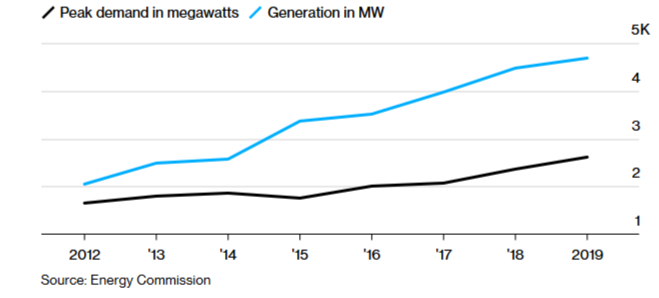
When President Nana Akufo-Addo came to power in 2017, he started the sale of so-called energy bonds on the back of fuel levies to clear the outstanding liabilities. This helped cut the debt by half by early 2018, though more bonds haven’t been sold because there isn’t enough revenue to support them.
State-owned Electricity Co. of Ghana Ltd. has suffered an estimated annual revenue loss of $580 million due mainly to transmission leakages, illegal connections and unpaid bills. Plans to tackle the problem by introducing private investors under a U.S.-funded aid program failed to win approval. The company’s managing director, Kwame Agyeman-Budu, could not comment immediately when he was reached on phone.
Much help isn’t coming either from the West African Power Pool project, under which member countries could sell their excess power to neighbors. While Ghana was a net exporter of 967 megawatts of electricity to other countries in 2019, further exchange is hindered until 2023, when current interconnection projects will be completed.
The coronavirus pandemic pushed Ghana further into financial straits. It responded with more than 3 billion cedis ($519 million) in unplanned spending that included providing free electricity and water to citizens, tax waivers and credit to small businesses, a situation that made it difficult to keep up with the debt repayments, according to Finance Minister Ken Ofori-Atta.
“When you have limited resources in a Covid environment you have to be specific about what you’re paying and how much you pay,” Ofori-Atta said in a phone interview. “We’ve tried to keep the lights on for these four years.”
Ghana’s public debt increased to 258 billion cedis by the end of June, equivalent to 67% of gross domestic product, from 61% at the end of March. The government previously said it will use $1 billion of the $3 billion raised from the sale of a Eurobond in February to help producers refinance their commercial loans.
The two sides haven’t reached an agreement, according Elikplim Apetorgbor, chief executive officer of the power chamber.
The country’s dollar bonds made returns of 2.9% for investors this quarter, compared with 4.4% in emerging markets, according to Bloomberg Barclays indexes.
The potential constraints on Ghana’s creditworthiness make it imperative that the government attends to the debt problem in the power industry urgently, according to Gregory Smith, a fixed income strategist at M&G Ltd. in London.
“Responding to the immediate threat of the pandemic became essential,” Smith said. “Once the pandemic is beaten the focus and finances should shift back to ensuring the financial viability of the electricity sector.”
By Moses Mozart Dzawu
With assistance from Gina Turner
source: Bloomberg

SolarTaxi introduces first electric vehicles into Ghanaian transport sector
SolarTaxi introduces first electric vehicles into Ghanaian transport sector. SolarTaxi Limited has introduced electric vehicles into the Ghanaian transport sector. The vehicle which comes in different types is the first of its kind to be introduced in Ghana for commercial use.
SolarTaxi is an initiative started by Kumasi Hive and sponsored by Mastercard Foundation that seeks to create environmental, social and economic impact in Ghanaian communities, by harnessing the renewable energy of the sun and using it to power vehicles.
During the launch of the electronic vehicles, Operations Associate at SolarTaxi, Kate Duah told Joy Business the firm has achieved their target of creating employment for Ghanaians.
“Through this initiative, we’ve been able to create employment for the youth. As you can observe, there are so many young people in our staff. And we’ve been able to empower women also.
“All our engineers are female and they actually built the electric bikes with imported parts from China. We are also using these electric cars to mitigate climate change”, she noted.
The Chief Executive Officer of SolarTaxi, Jorge Appiah also indicated that “electric vehicles as an innovative transportation alternative have the potential to mitigate climate change and also provide affordable transportations for Ghanaians.
By leveraging the energy from the sun and innovativeness of the shared economy electric vehicles reduce carbon emissions, cost of delivery and transport services to individuals and businesses across the country”, he stated.
The company is currently providing leasing services for its EV cars at affordable rates for as low as GHS 800 per month for the hatchback, GHS 900 per month for the sedan and GHS 1,000 per month for the SUV.
Deliveries of cars are expected to commence on September 1, 2020. Outright purchase of the electric vehicles have already begun
source: myjoyonline.com

Registrar-General’s Department introduces sweeping reforms in business registration under new Companies Act, 2019 (ACT 992)
Registrar-General Jemima Oware has announced new changes to the processes and procedures of registering companies in the country to promote the government’s efforts at improving the ease of doing business in Ghana.
She stated that the E- Registrar software application has finally been upgraded in accordance with the new Companies Act, 2019, (Act 992).
Commencing from September 28, 2020, members of the business community who wish to register new companies would have to visit the Department’s website and download the new prescribed Forms and complete them appropriately for the six types of Company registration.
“There would be no need to fill a Form 4 and the Regulations for the incorporation of a company. The new Prescribed Forms uploaded on the website encompasses every detail that would have been filled in the previous Forms for the six types of Companies, ”the Registrar-General hinted.
According to her, another change that has been introduced with the implementation of Act 992, is that persons who are registering any of the six types of companies listed below would have had to fill Regulations for all these types of companies.
- Private Companies Limited by shares,
- Private Companies unlimited by shares,
- Public Company Limited by shares,
- Public Company unlimited by shares,
- Private Company limited by Guarantee and
- Public Company Limited by Guarantee
“Now we have made it easier, we have Constitutions to replace Regulations for all Companies. One can just adopt Schedules 2, 3 or 4 of Act 992 which represents the Constitution for a Private Company Limited by Shares, a Public Company Limited by Shares and a Private Company Limited by Guarantee respectively.
All of these Schedules are available on the website as your Constitutions to be adopted together with the different Prescribed Forms for the different types of Companies. ” Jemima Oware stated.
The Department has also designed Constitutions for Private Companies Unlimited by Shares, Public Companies Unlimited by Shares and a Public Company Unlimited by Guarantee that can be adopted at the point of registration together with the Prescribed Forms for the different types of Companies.
All such Promoters who choose to adopt the prescribed Constitutions would not be mandated to provide objects but would be required to disclose which sectors the Company would be operating in through the ISIC codes provided on our electronic eRegistrarsoftware.
Promoters of Companies could also download the Prescribed Forms for the different types of Companies and attach their own Registered Constitution which should necessarily have objects.
She advised that all other companies that are not regulated by the RGD, but by different Regulators would have to register their Companies with their own Registered Constitutions and disclose the specific objects in these Registered Constitutions.
Examples of Companies regulated by other institutions are for example Banks, Microfinance and Microcredit Companies regulated by Bank of Ghana, Companies with Foreign participation regulated by GIPC, Companies in Academia regulated by the Accreditation Board, Security Firms regulated by the Ministry of Interior, Companies in the Securities Industry and Capital Markets regulated by the Securities And Exchange Commission and the Ghana Stock Exchange, the Extractive Industry regulated by the Minerals Commission, Petroleum Commission, Companies operating in the Free Zones Enclave, Companies engaged in betting regulated by the Gaming Commission, Legal Firms, Architectural Firms.
She further emphasised that the Act also does away with the Certificate to Commence Business or the need to swear before a Commissioner of Oath since the Act does away with Form 4 entirely.
Strengthening Corporate Governance under ACT 992
The Registrar-General indicated that one key benefit of the new business law is its inherent strict requirements that would improve corporate governance going forward in the implementation of the Act.
“The time where Companies only existed on paper is over” Jemima Oware warned.
According to Jemima Oware, under Act 992, a person shall not be appointed as a Director of a company unless the person has before the appointment submitted to the Company a Statutory Declaration to the effect that the Director has not within the preceding five years before the application been charged or convicted of a criminal offence involving fraud or dishonesty, or been charged with or convicted of a criminal offence relating to the promotion, incorporation or management of a company; or has been a director or senior manager of a company that has become insolvent.
The Act further states that if even the director has done any of the above, he/she must state the date of the insolvency and the particular company.
For the first time, the Director must also consent to be a director and must file the consent within 28 days with the Registrar at incorporation to show that they have expressly given permission for their data to be put into the system as directors of the said company.
Again, Act 992 also specifies who qualifies to be a Secretary of a company which was not the case previously.
The Company Secretary for any Company under Act 992 must have obtained a professional qualification or a Tertiary level qualification that enables this Company Secretary to have the requisite knowledge and experience to perform the functions of a Company Secretary;
- or must have held office before the appointment as a Company Secretary trainee or been articled under the supervision of a qualified Company Secretary for a period of at least three years,
- or is a member in good standing of the Institute of Chartered Secretaries and Administrators; or the Institute of Chartered Accountants;
- or a barrister or Solicitor in good standing ,
- or by virtue of an academic qualification, or as a member of a professional body, appears to the directors as capable of performing the functions as the secretary of the company.
“It is also no longer going to be business as usual where people pick already prepared Auditors Letters of Consent placed at vantage points in the Department.
Under Act 992, a company must have an Auditor who is qualified and licensed in accordance with the Chartered Accountants Act, 1963(Act 170); and not disqualified for being an officer of the company or of an associated company.
A novel provision in this Act 992 is that an Auditor shall now hold office for a term of not more than six years and be eligible for re-appointment after a cooling period of not less than six years, the Registrar-General noted.
These Officers of the Company must swear on their own oath that they are indeed qualified to be Directors,Secretaries or Auditors of the Company.
All officers must also be 18 years and above, another novelty in Act 992 since the age of majority is no more 21 years, but 18 years.
Jemima Oware further explained that the current system would accept a mandatory digital address downloaded from the Ghana Post App for the stated Principal place of business and Registered Place of Business as well as a valid email address otherwise the address would be rejected and the application not processed.
ACT 992 and Beneficial Ownership disclosure
The Register-General Jemima Oware, further stated that under Act 992, the RGD is deploying a new Central Beneficial Ownership Register for all companies operating in the country.
“We will start with requesting for Bio Data from the Extractive Industry and other high risk sectors like Banks and other Financial Institutions,” she noted.
According to her, a lack of information about who owns and controls businesses incorporated in Ghana is creating a “dangerous and widening gap” in the country’s fight against corruption, money laundering, terrorism financing and other forms of financial crimes.
Beneficial ownership is a term in domestic and international commercial law that refers to the natural persons who exercise significant influence over and receive profits from a company who are not its legal owners.
“Some people can assign a “nominee” in relation to their shareholding or directorship position at the board and they would be at the back end controlling affairs, they would have a legal arrangement with such persons that we would not be privy to…but things have changed now, she disclosed.
Jemima Oware explained that from the 28th of September 2020, whoever wishes to register a company to operate in the Extractive industry should visit www.rgd.gov.gh, download the Beneficial Ownership Form and provide the data on who the beneficial owners of the company are.
Change of company names and suffixes
The Registrar-General announced that every company in Ghana would now have suffixes ending the names of their Companies that would immediately indicate which kind of entity the company name fell under. For example, the suffixes ending the different types of companies would be as follows:
- Private Company Limited by Shares would end with Limited Company or LTD
- Private Unlimited Liability Company would now end with PRUC.
- Public Limited Company would now end with PLC.
- Public Unlimited Liability Company would now end with PUC;
- Companies Limited By Guarantee would have the suffix LBG; and
- Public Company Limited By Guarantee would now end with PLBG
“New companies that we would register from October would now have these new suffixes.
The Department would through a Press Release provide a period within which all existing companies would have to comply by passing special resolutions at their various Boards to change their names by attaching these different suffixes to their company names depending on which type of Company the name fell under,” she added.
The Registrar-General, Jemima Oware, appealed to the general public and the members of the business community to co-operate with the Department as it goes through the process of upgrading the system to ensure a smooth transition.
There will be periodic Press Releases for all clients and customers to be abreast with all the changes of the Companies Act, 2019, Act 992 as and when they would be deployed by the developers of the eRegistrar software.
source: myjoyonline.com