
1. Ghana partners with Giesecke + Devrient (G+D) to pilot a general purpose Central Bank Digital Currency (CBDC) in Ghana.
2.CBCD presents a great opportunity to build a robust, inclusive, competitive and sustainable financial sector led by the Central Bank according to Dr. Addison
3. The CBDC will use Giesecke + Devrient filia solutions which includes the ability to conduct offline payments, a flexible balance between privacy and transparency and the opportunity to integrate filia into larger payment ecosystems.
4. The CBDC serves as an opportunity to eliminate the need for a Bank account, requiring a smartphone or other form of digital wallet.
5.The BoG is in the advanced stages of introducing a digital currency as disclosed by Dr. Addison, the governor of the Central Bank.
6. Before the E-Cedi goes into circulation, it will go through three phases of which the final stage will determine whether the digital currency will be feasible.
7. The team after advancing in the first phase to design the electronic money, are looking into the implementation phase and finally the pilot stage which allows a few people to use the digital cedi on the mobile App.
8. The final stage helps identify what sort of things needs to be adjusted to make it work effectively.
9. Filia guarantees outstanding security, high availability and resilience as well as the ability to protect user data while complying with regulatory requirements.
10. It is worth noting that the activities of crypto currencies were currently not regulated because of their volatility.
11. As part of the Digital Ghana Agenda, the Bank of Ghana is in partnership with Giesecke + Devrient (G+D) to pilot a general purpose Central Bank Digital Currency (CBDC) also known as the E-Cedi.
12. The issuance of the E-Cedi is intended to complement and serve as an alternative to physical cash in Ghana, facilitate payments without bank accounts, contracts or smartphone.
13. The E-Cedi before rollout will undergo a pilot phase where a diversified user groups will test and share their perspectives and experiences to provide Bank of Ghana and G+D make adjustments and determine the acceptance or otherwise of the E-Cedi.
14. The Ghanaian government according to Dr. Wolfram Seidemann is one of the first African countries entering into a pilot phase of the digital currency project.
15. The CGBC Solution adopted for the E-Cedi project is called Filia. Filia because it guarantees outstanding security, high availability and resilience, user data protection, secure, consecutive offline payments and it fulfils all regulatory requirements.
Reflection on the Framework of Competition Law in Ghana in Light of the African Continental Free Trade Area Agreement
Introduction
The African Continental Free Trade Area (“AfCFTA”) was officially launched on 1 st January,2021. The purpose of the AfCFTA is to create an intra African single market for goods and services by progressively eliminating tariffs and non-tariff barriers to trade. The AfCFTA is regulated by the Agreement Establishing the African Continental Free Trade Area (the “Agreement”). 54 African countries are currently signatories to the Agreement with 36 signatories ratifying the Agreement.
The Agreement comprises three frameworks: An overarching establishment of the African Continental Free Trade Area, a Protocol on Trade in Goods, and a Protocol on Trade in Services. The Protocol on Trade in Goods outlines the general rules by which goods can be traded in the free trade area. The Protocol of Trade in Services also outlines the general rules to facilitate trade in services across the free trade area. These protocols are starting points for countries to negotiate other trade related issues such as intellectual property, investment and competition. This article highlights reasons the competition law framework in Ghana must be amended in light of the AfCFTA.
Overview of Competition Law
Competition referred to in this article is “a relationship that exists among any number of firms engaged in selling goods or services of the same type at the same time to an identifiable group of persons”. Competition law or antitrust law is essentially the law that regulates and fosters competition between firms in the same market. Competition law helps to provide similar conditions for businesses in the marketplace while creating space for upcoming smaller businesses. The goal of competition law is for consumers to be offered goods and services at favourable prices.
Importance of Competition Law
Competition law is important for the survival of local businesses. Without competition law, the market will be governed by the “survival of the fittest rule” where big firms eliminate competitors and monopolise the markets. Competition law does not only benefit small businesses, but it also seeks the interest of the consumer. When firms monopolise the market of a product or services,consumers are usually forced to pay exorbitant amounts for the product or service that could have been offered for less. Consumers are also faced with limited choices. Monopoly in the market also increases complacency as firms can offer low quality products or services without worrying about competition or losing customers especially when offering essential services.
Globalisation & Competition Law
Globalisation has expanded the market potential of firms beyond their municipal states. Travelling and transporting goods has become easier over the years, supporting international commerce. Economic communities such as the European Economic Area, the South Asian Association for Regional Cooperation and the AfCFTA are convenient markets for firms to trade internationally without the encumbrance of high tariffs. International trade without the intervention of competition law may cause the demise of small local businesses and lead to the dominance of international conglomerates and corporations.
Importance of Competition Law
Competition law is important for the survival of local businesses. Without competition law, the market will be governed by the “survival of the fittest rule” where big firms eliminate competitors and monopolise the markets. Competition law does not only benefit small businesses, but it also seeks the interest of the consumer. When firms monopolise the market of a product or services, consumers are usually forced to pay exorbitant amounts for the product or service that could have been offered for less. Consumers are also faced with limited choices. Monopoly in the market also increases complacency as firms can offer low quality products or services without worrying about competition or losing customers especially when offering essential services.
Competition Law in Ghana
The Protection Against Unfair Competition Act, 2001 (Act 589) (the “Act”) is Ghana’s effort to legislate competition and proscribe anti-competitive practices. Comprised of just ten major provisions, the Act summarily addresses a few anticompetitive practices.
- Section 1 of the Act frowns upon using trademarks, trade names or other identifiers that would confuse or is likely to be confused with another’s enterprise or its activities.
- Sections 2, 3 and 4 address issues affecting an enterprise’s reputation either by damaging its goodwill or reputation, misleading the public or discrediting another
enterprise or its activities. - Section 5 forbids using secret information obtained illegally in a manner contrary to honest commercial practices.
- Section 6 of the Act also forbids actions that breach international obligations that Ghana is subject to.
- Section 7 constitutes a general provision blanketing any act or practice that is contrary to honest practices as an act of unfair competition.
Honest practices or honest commercial practices are not defined in the Act. A breach of the provisions in the Act entitles the person against whom the breach is committed to civil remedies such as: (a) An order of injunction to prevent the act or further acts of unfair competition; (b) A provisional order to prevent unlawful acts or to preserve relevant evidence; (c) The award of damages as compensation; and (d) Any other remedy as the court may consider fit to order.
The Act is deficient and cannot effectively regulate competition in the Ghanaian market. Consequently, the Competition and Fair-Trade Practices Bill was drafted in 2004 but has failed to be enacted till date. Aside from lacking provisions to regulate more anticompetitive practices, the Act also neglects to establish a good enforcement mechanism.
The Act leaves its enforcement to affected business owners or persons and the courts. In Georgina Achiaa v Don Emilio Company Limited , the court held that infringing on the distribution rights of a licensed sole distributor amounted to an unfair trade practice under section 7 of Act. Although this decision lends some support to the Act, the Act as it is fails to protect small business owners who may not have the resources to hire a lawyer to seek redress in court. Furthermore, this enforcement mechanism is only available to persons who are damaged by or are likely to be damaged by the unfair trade practice. It is unclear whether ‘persons’ includes consumers as it is not defined in the Act. Regardless, the Act does little to prevent the formation of cartels or prevent competitors’ anticompetitive agreements leading to monopoly and price fixing that unduly burden the consumer.
Good competition legislation creates a competitive market where businesses are given equal opportunities to carve their niche in the market by offering quality goods and services to consumers at the best prices. Systematic checks and processes, commissions and institutions are useful mechanisms to enforce competition. The purpose of competition is to benefit businesses and consumers. Unfortunately, it appears that the Act only considers how some unfair trade practices may affect businesses without considering the consumer.
Competition in the EU
The EU has been in existence since 1993 and the European Economic Area since 1994. Competition was addressed in the Treaty on the Functioning of the European Union (the“Treaty”). The first article on competition in the competition framework of the Treaty prohibited agreements, decisions or practices that promoted price fixing, limiting development and production, sharing markets, placing trading parties at different competitive advantages by applying better conditions to one over the other, subjecting parties to a contract to supplementary obligations which have no commercial bearing or are usual to the subject of the Agreement. Thus, parties in an agreement, are bound to the existing EU competition rules and are thereby prohibited from abusing market dominance positions and carrying out anti-competitive practices.
The Treaty deems decisions or agreements made in contravention of the above automatically void. The Treaty then proceeds to prohibit monopoly by banning abuse by undertakings in a dominant position. State aid that distorts or threatens to distort competition by granting undertakings or productions an unfair advantage in the market is also prohibited State aid that does not fall under the above is welcomed. The remainder of the framework addresses developing regulations and enforcement strategies to give effect to the substantive articles on competition in the Treaty. Article 106(1) prevents member states from enacting or maintaining any measure contrary to those in the Treaty. The EU is also intentional to include competition policies in international treaties and agreements it has with other continents and countries that
are not members of the EU.
Unlike Act 589, several factors contribute to the making and enforcement of competition policies in the EU. Chapter I and II of the UK Competition Act 1998 prohibits anti-competitive behaviour that may affect trade between EU member states. In effect, both EU and UK laws prohibit any arrangement, agreement or concerted business practices which will significantly prevent, distort or restrict competition, or where this is the intended result, which may affect trade within the UK or EU. The consequences of a breach/infringement of Article 101and 102 (Chapter I&II) may include, but not be limited to, fines of up to 10% of group global turnover, render agreements
unenforceable/void, mass action suits from consumers or competitors or court injunctions and the disqualification of individuals from acting as company directors as well as risking prosecution under the criminal cartels’ offences.
The European Commission oversees the enforcement of competition rules in the EU. The European Parliament has two competition committees that help develop competition policies and strategies. The European Court of Justice interprets competition law to ensure a uniform application throughout the EU. The European Social and Economic Union which is constituted of civil society unions like trade unions that highlight issues and opinions contributing to the decision-making process of competition policies. The Commission allows citizens of State Parties to lodge formal complaints of anticompetitive practice for further investigation. There is much that Ghana and the AU can learn from in developing a competition law framework and enforcing it from the EU’s example. Competition law and compliance is highly valued by the EU for good reason. Ghana and Africa can learn some lessons from the EU which can be applied to our unique markets.
Why Competition law is important in the Age of AfCFTA
As part of the Phase II operationalisation of the Agreement, state parties will be expected to submit competition policies and strategies demonstrating how competitiveness will be handled in their jurisdiction. During the AfCFTA Start of Trading ceremony, it was confirmed that eleven state parties had brought forward their competition strategies and have earned approval. The deadline for the completion of negotiations on Phase II is 31 st December, 2021.
The Act neglects to fully address anticompetitive practices such as price fixing, abusing market dominance, trade association rules and exclusive dealing making and others. Price fixing includes the use of predatory, excessive and discriminatory pricing methods or anticompetitive trade association rules such as tying; which stipulates that a buyer wishing to buy one product must purchase some or all their requirements for a second product from the dominant supplier. The abuse of market dominance refers to instances where the dominant market shareholder or companies with over 50% market share or dominance imposes unfair trading terms and conditions.
The AfCFTA will open the markets of state parties populated by SMEs to more developed stateparties with giant corporations. To ensure fair competition, each state party must have competent competition laws and strategies to enforce same. There have been many calls over the years for a more comprehensive competition legislation especially with Ghana’s growing economy and the flooding imports of cheaper foreign products which have a high propensity to drown domestic products. Several local factories have been forced to close down because they could not compete with the cheaper products imported from countries with cheaper costs of
production and those that enjoy government subsidies. It must be noted that, even indigenous products like African print cloth are now dominated by foreign businesses and foreign manufacturers. The lack of a national competition policy acts as a disincentive for Ghanaianbusinesses to innovate to be able to compete with foreign businesses. The commencement of the AfCFTA may worsen the plight of the Ghanaian local industry if due action is not taken considering the fact that 88% of businesses in Ghana are considered small and medium scale.
The current law is insufficient to regulate competition in Ghana. Good competition policies coupled with enforcement can help Ghana regain more control over its market and combat the unwanted effects of high competition that the AfCFTA would bring. Since the AfCFTA is now officially in operation, it has become even more urgent for Ghana to review and upgrade its competition framework by amending to provide the required protective mechanisms for the SMEs. A good competition framework would prevent the Ghanaian economy from being controlled by businesses with foreign identities or allegiances to the detriment of Ghanaian businesses or consumers. Ghana’s competition framework must delicately balance protecting domestic businesses and making Ghana business friendly to other State Parties within the EU.
Written by Sharon Okai a Legal Intern at Koranteng & Koranteng Legal Advisors
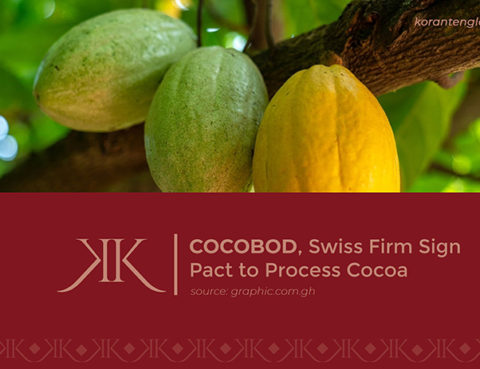
COCOBOD, Swiss Firm Sign Pact to Process Cocoa
The agreement also enables the country to tap into the expertise of the company in chocolate processing through training, product development and technology guidance to help build a robust local capacity in cocoa processing and value addition to meet both domestic and international consumption demands.
The agreement was signed at Buhler’s Abidjan office in Cote d’Ivoire last Sunday.
The Chief Executive of COCOBOD, Mr Joseph Boahen Aidoo, signed on behalf of the board, while the President of Buhler for the Middle East and Africa, Mr Heiko Feuring, initialled it for the company.
Impact
The CEO of COCOBOD said the agreement would deepen the strong relationship between Ghana and Switzerland, as well as enable them to share more experiences in cocoa processing, where both are significant players.
Mr Aidoo said Buhler was one of the top-class organisations in the world when it came to chocolate technology and expressed the hope that Ghana would leverage the agreement to also enrich its cocoa sector.
He said the country had begun a journey on the path of transformation in its cocoa sector and had been looking out for such partnerships to aid the process.
“We want to move from traditional cocoa production to a modern way of cocoa production. We also want to move from the supply of the mere primary commodity to value addition, and that is where we find you to be a partner,” the COCOBOD boss said.
He added that Ghana needed to build its capacity to add value to the cocoa it produced, and that meant it had to acquire the latest technologies for efficient processing, as well as chocolate and other cocoa product development.
“You have the technology and we need the technology, so we want to work together. This partnership we are forging today should continue to grow into the future and remain beneficial to the mutual interest of Ghana and Switzerland,” Mr Aidoo said.
Response
For his part, Mr Feuring commended the COCOBOD CEO and his management team for their efforts towards building a sustainable and prosperous cocoa value chain for Ghana through the introduction of farm improvement activities and the implementation of the Living Income Differential (LID).
“We hope this memorandum of understanding will be the landmark of a new fruitful and long-lasting collaboration to unlock the Ghanaian cocoa value chain potential.
“We want to support Ghana in its march towards a higher value creation for the benefit of all Ghanaians,” he said.
Mr Feuring gave an assurance that Buhler would offer its expertise to Ghana in its effort to build a solid local processing industry to tap into the $100 billion cocoa and chocolate industry.
source: graphic.com
Abolition of Unfair Fees, Charges and Other Practices in the Banking Sector
The Bank of Ghana has observed with concern, a trend where some Banks and Specialized Deposit-Taking Institutions (SDIs) impose certain fees and charges on customers. These practices are deemed to be unfair, inappropriate and detrimental to the financial inclusion agenda and the protection of customers’ interest.
source: graphic.com

Ghana To Be Removed From EU Money Laundering List by June 2021
Ghana is expected to be removed from the list of countries with high levels of deficiencies in Anti-Money Laundering (AML) and Counter Terrorist Financing (CTF) regimes.
The exclusion of Ghana from the list is expected to be announced in June this year.
Background
The European Commission in May 2020 listed Ghana and 11 other countries as having lapses in the country’s AML and CFT regimes, thus posing significant threats to the European Union’s financial system
The inclusion of Ghana in the blacklist meant that financial transactions from Ghana into the EU and vice versa received extra scrutiny to ensure that they did not escape the “deficiencies” identified to the benefit of money launderers and terrorist financiers.
A similar action was taken on Ghana in 2019.
The Decision to Remove Ghana From the EU Money Laundering List
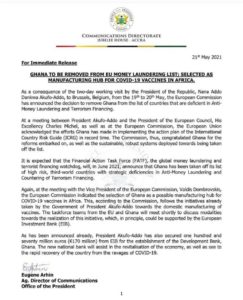
A statement signed and issued by the Director of Communications at the Office of the President, Mr. Eugene Arhin, said the European Commission made the decision to take Ghana off the list following a meeting with President Nana Addo Dankwa Akufo-Addo in Brussels, Belgium.
According to the statement, at a meeting between President Akufo-Addo and the President of the European Council, His Excellency, Charles Michel, as well as at the European Commission, the European Union acknowledged the efforts Ghana has made in implementing the action plan of the International Country Risk Guide (ICRG) in record time.
“The Commission, thus, congratulated Ghana for the reforms embarked on, as well as the sustainable, robust systems deployed towards being taken of the list,” it said.
It added that it is expected that the Financial Action Task Force (FATF), the global money laundering and terrorist financing watchdog, will, in June 2021, announce that Ghana has been taken off its list of high risk, third-world countries with strategic deficiencies in Anti-Money Laundering and Countering of Terrorism Financing.

Nano Foods Opens its Pineapple Processing Factory
Nano Foods Limited, formerly ASTEK Refresh Pineapple Juice Company has been revitalized. At the inauguration of the food processing company situated in Nsawam, a call was made on Ghanaians to explore all opportunities in the traditional sector of the economy to accelerate the national economic transformational agenda.
The project, which is under the One District, One Factory (1D1F) programme, brings to 77 the number of factories in operation since the inception of the initiative in 2017.
Nano Foods Limited, which came out of the defunct ASTEK Refresh Pineapple Juice Company in the 1980s and 1990s, had only been producing ASTEK Nsu sachet water since it was revived in 2014.
It presently provides about 100 direct jobs for Ghanaians, with hundreds of indirect jobs in the Eastern and the Central regions.
In December 2018, the Ghana Exim Bank approved a capital expenditure loan and a working capital facility of $1,067,600 for the company, which went on to acquire and install a complete pineapple processing and canning line, together with a modern and efficient quality control laboratory.
Economic Transformation through Agriculture and Exports
This comes as part of the government’s efforts to transform the economy through agriculture. Nano Foods Limited would be processing pineapples from farms located mainly in the Eastern and the Central regions. Its products would be exported to the United States, Western European and Middle East markets to meet the constant demand primarily from Spain, Hungary and Cyprus.
The export-driven aspect of the project would help consolidate the successes achieved so far in improving the country’s trade balance and its foreign exchange reserves.
“For the first time in over two decades, the trade balance, which is the difference between what the country exports and what it imports, recorded a surplus for four consecutive years from 2017 to 2020. Ghana’s Gross International Reserves had also increased from $6.1 billion (3.5 months of imports) in 2016 to $8.6 billion in 2020 (4.1 months of imports),” the Vice-President stated at the inauguration.
Industrial transformation
The revamping of the defunct ASTEK Refresh Company into Nano Foods Limited is designed to add value to the natural resources at the grass-roots level to provide decent job opportunities for the youth and women. It is also geared towards reducing the importation of goods through import substitution in order to provide opportunities for export.
Future Plans of Nano Foods Limited
The company is expected to re-introduce the ASTEK Refresh juice drinks as part of its second phase of development. This would require a further investment of $2 million. With the further investment, it would be able to achieve a turnover of over $10 million with a labour force of about 300 working for the company in the next two to three years.
The Managing Director of Nano Foods Limited, Mr. Albert Anti Owusu, added that the company also had plans to increase its production line by introducing tiger nuts, cocoa beans, snails and garden during the second phase for export
source: graphic.com.gh

Ghana’s novel zero-coupon bond: Dr. Gideon Boako’s take
Ghana is the first Sub-Saharan African country to issue a foreign currency-denominated zero-coupon bullet tranche to its bond financing mix, enabling it to create fiscal space to build its financial resilience.
Ghana’s debut 4-year zero-coupon bond was two times oversubscribed, despite being the first of its kind to be issued by a West African sovereign, further demonstrating investors continued support for Ghana’s transformation story and strong fiscal consolidation efforts.
Zero-coupon bonds are bonds issued without any interest, hence trades at a discount till maturity. Thus, unlike other traditional coupon-bearing bonds, Ghana will not pay any interest on the four-year zero-coupon bond. The only debt obligation that the government of Ghana would have to honor will be the face value of $525 million on maturity.
The practical mechanics of a zero-coupon bond
For the purposes of illustration, let me apply some indicative figures and later crown them with the actuals from the 2021 issuance.
Assuming Ghana issues a $500 million zero-coupon bond at a discounted rate of 20% ($100 million), Ghana will receive $400 million in cash today but pay back $500 million when the bond matures in four years. However, in the interim, Ghana will not pay any interest over the four (4) years.
This bond structure means the government can use the money it would have used in making interest payments over the next four (4) years for other productive opportunities. In the case of Ghana for this bond, the government has the intention of using the proceeds to refinance more expensive domestic debt, which attracts an average of 19% interest rate.
So Ghana is borrowing at no interest and using the proceeds to pay existing debt with higher/expensive interest rates.
How does this benefit Ghana?
Ghana’s existing domestic bonds attract an average interest rate of about 19% (make it 20% for ease of analysis). So here, Ghana issues a 20% discounted zero-coupon foreign bond at $500 million and receives $400 million. If the $400 million is converted to Cedis, say at a cedi-dollar exchange rate of 6, that is equivalent to approximately GHc2.4 billion.
This can be used to retire existing domestic bonds, which currently pay an interest of 20%. This will save Ghana GHc480 million Cedis in interest savings a year {that is 20% multiplied by GHc2.4 billion).
Multiplying the GHc480 million a year by four years gives GHc1.92 billion (the equivalent of $320 million) in savings over the four years. If we deduct the $100 million we pre-paid upfront on the zero-coupon from the $320 million, we get our net savings which come to $220 million in savings over the four years.
Actual computations from the 2021 Zero-coupon bonds.
- Ghana issued the zero-coupon bond for $525 million and received a discounted value of $409.5 million. Meaning the discounted value forgone for Ghana is $115.5 million.
- Converting the $409.5 million to cedis at the prevailing cedi/dollar exchange rate of 5.71 gives GHc2.338 billion.
- Existing local bonds for which we will use the zero-coupon bond proceeds to finance, attract an average interest rate of 18.3% (0.183).
- Multiplying 0.183 by 2.338 by 4 (years) gives GHc1.712 billion.
- Converting the GHc1.712 billion to dollars gives $299.7million
- Now, if you subtract the discounted $115.5 million from the $299.6 million, Ghana is making a net savings of $184.2 million, the equivalent of GHc1.1 billion
- Thus, based on what Ghana will use the zero-coupon bond for (financing existing expensive local bonds), Ghana will make savings of $184.2 million (GHc1.1 billion).
Why this $3 billion zero-coupon bond is a novelty worth celebrating
Coronavirus more than calls on all national economies’ managers to devise innovative financial engineering techniques for accelerated recovery and Ghana is doing something unique. It is a plus for all Ghanaians and the managers of the economy.
source: myjoyonline.com
The author, Dr. Gideon Boako is a Financial Economist with years of experience in academia, public policy formulations, and governmental and non-governmental consultancies. Currently, he serves on Ghana’s Economic Management Team (EMT) as Technical Advisor at the Office of the President, as well as, the Spokesperson to the Vice President of the Republic of Ghana, who chairs the Economic Management Team.
More on the zero-coupon bond: Koranteng & Koranteng Advises on Issuance of 2021 $3 Billion Eurobond
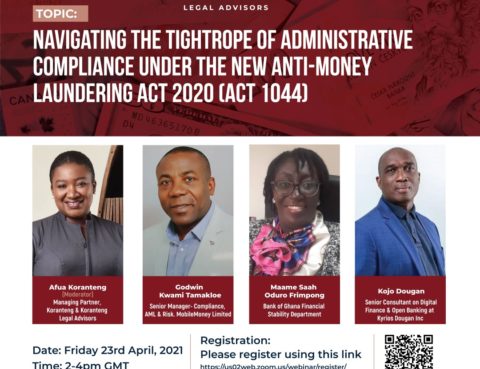
Navigating the Tightrope of Administrative Compliance under the New Anti-Money Laundering Act, 2020 (Act 1044)
Koranteng & Koranteng Legal Advisors is hosting a zoom webinar on the topic:
Navigating the Tightrope of Administrative Compliance under the New Anti-Money Laundering Act 2020 (Act 1044)
The panelists are …
- Godwin Kwame Tamakloe (Senior Manager -Compliance, AML & Risk, MobileMoney Limited)
- Maame Saah Oduro-Frimpong (Bank of Ghana Stability Department)
- Kojo Dougan (Senior Consultant on Digital Finance & Open Banking at Kyrios Dougan Inc)
And the discussions will be moderated by our Managing Partner, Afua Adubea Koranteng
Date: Friday Apr 23, 2021
Time: 2:00pm-4:00pm Greenwich Mean Time
Register in advance here: https://us02web.zoom.us/webinar/register/WN_RWBOw4a_QDKxv5LICfN7OQ
After registering, you will receive a confirmation email containing information about joining the webinar.
Watch Video
Koranteng & Koranteng Legal Advisors Acts as Joint Local Counsel on Landmark $3 Billion Eurobond Issuance by the Republic of Ghana.
Koranteng & Koranteng Legal Advisors is proud to have advised the Ministry of Finance on the Republic of Ghana’s Landmark 2021 $3 Billion Eurobond issuance. The landmark transaction was in excess of $3 billion and involved a 4-year zero-coupon tranche of $525 million. This is the first of its kind to be issued by a sub-saharan African sovereign. The transaction also comprised US$1 billion 7-year notes at 7.75%, US$1 billion 12-year notes at 8.625% and US$500 million 20-year notes at 8.875%. Investors have demonstrated a continued confidence in the Republic of Ghana with such a positive market response amidst the Covid-19 pandemic, with its attendant virtual roadshows and investor presentations. Ghana intends to use the proceeds to support its budget deficit by funding growth-oriented expenditures and conducting liability management.
Find out more on Government of Ghana Eurobonds at gse.com.gh
Penalty and Interest Waiver Act 2021 (Act 1065)
Introduction
The Penalty and Interest Waiver Act 2021 (the “Act”) was passed by Parliament and assented to by the President on the 31st March, 2021. The scope of the Act is to “grant a waiver of penalties and interests on accumulated tax arrears up to December 2020 for persons who make arrangements with the Ghana Revenue Authority for payment of the principal tax by 2021and to provide for related matters.” This document will outline the key provisions in the Act.
Application and Grant of the Waiver
To obtain this waiver, persons who qualify under the scope of the waiver must between 1st April, 2021 and 30th September, 2021, submit a written application to the Commissioner-General in a form so prescribed by him, and submit outstanding returns in respect of previous years up until the 31st December, 2021.
Within 30 days of this submission, the Commissioner-General is required to serve the applicant with notice of the Commissioner-General’s decision regarding the application. Where the application for the waiver is refused, the Commissioner-General is required to outline the reason for the refusal in writing.
An applicant who is dissatisfied with the decision of the Commissioner-General may lodge a written complaint with the Commissioner-General within 30 days of receipt of the decision. The Commissioner-General is required to make a determination and notify the applicant accordingly. Where the applicant is dissatisfied with this subsequent determination, he may pursue the matter in a court of competent jurisdiction.
Terms of Payment and Remission of Taxes
Terms of payment of an assessed amount and outstanding tax arrears may be granted and determined by the Commissioner-General. Importantly, the Act does not derogate from the power of the Commissioner-General to remit taxes under an enactment administered by him.
Conclusion
The Act provides relief to taxpayers who for one reason or the other were unable to pay taxes, been in arrears or have not yet registered with GRA. With the enactment of this Act, individuals and companies with the assistance of their legal and tax advisors determine their tax liabilities and negotiate a payment plan for such outstanding taxes. This will draw more individuals and companies into the tax bracket while existing taxpayers will be able to meet their tax obligations in a manner that is convenient for them. Ultimately, if this process is well managed it will be a “win-win” situation for both the taxpayer and the tax collector.